
英语六级 2021年6月·第2套 · 真题整卷
按真题原卷顺序的全部题型,逐题型可进试卷排版、题目解析、原文精读;整卷可免费下载电子版(真题 PDF、解析版 PDF 与 Word)。
整卷试卷排版
六级 · 真题卷第2套 · 2021年6月
英语六级2021年6月·第2套真题
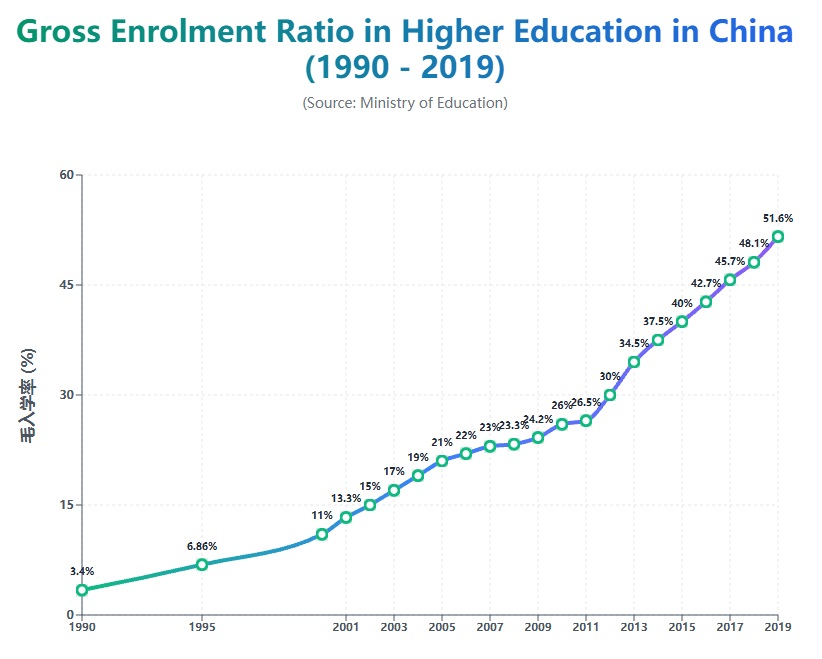
Directions: For this part, you are allowed 30 minutes to write an essay based on the chart below. You should start your essay with a brief description of the chart and comment on China's achievements in higher education . You should write at least 150 words but no more than 200 words.
英语六级2021年6月·第2套真题
Directions: In this section, you will hear two long conversations. At the end of each conversation, you will hear four questions. Both the conversation and the questions will be spoken only once. After you hear a question, you must choose the best answer from the four choices marked A), B), C) and D). Then mark the corresponding letter on Answer Sheet 1 with a single line through the centre.
Questions 1 to 4 are based on the conversation you have just heard.
1.
A)Weird.
B)Efficient.
C)Tolerant.
D)Toxic.
2.
A)They are arrogant.
B)They are ignorant.
C)They are ambitious.
D)They are accommodating.
3.
A)They can think big.
B)They can air their views.
C)They can break conventions.
D)They can work flexible hours.
4.
A)It can alter people's mindsets.
B)It can lead to new discoveries.
C)It enables people to learn and grow.
D)It is conducive to critical thinking.
Questions 5 to 8 are based on the conversation you have just heard.
5.
A)He kept looking for the best place to stay.
B)He met many tourists from other countries.
C)He had a great time sightseeing and relaxing.
D)He managed to visit a different city each day.
6.
A)Prioritize what is essential to their best advantage.
B)Stretch out the process in search of the optimal.
C)Deliberate the consequences that may occur.
D)Take all relevant factors into consideration.
7.
A)Time pressure.
B)Tight budget.
C)Modern technology.
D)Fierce competition.
8.
A)Research as many different options as possible.
B)Avoid going over the same options repeatedly.
C)Focus on what is practical.
D)Trust their gut instinct.
Directions: In this section, you will hear two passages. At the end of each passage, you will hear three or four questions. Both the passage and the questions will be spoken only once. After you hear a question, you must choose the best answer from the four choices marked A), B), C) and D). Then mark the corresponding letter on Answer Sheet 1 with a single line through the centre.
Questions 9 to 11 are based on the passage you have just heard.
9.
A)It is beneficial to poor as well as rich communities.
B)It is conducive to children's future development.
C)It is welcome to parents but not to children.
D)It is not of much help to younger children.
10.
A)It may put some students in remote areas at a disadvantage.
B)It gives the majority of students ready access to their teachers.
C)It effectively improves the learning quality of students in rural areas.
D)It can bridge the learning gap between kids of different backgrounds.
11.
A)Diligent students tend to do their homework independently.
B)The focus of homework should always be on school subjects.
C)Doing homework exerts a positive effect on kids' personality development.
D)The benefits of doing homework vary widely from individual to individual.
Questions 12 to 15 are based on the passage you have just heard.
12.
A)It was something he apologized for later.
B)It was ridiculed by the New York Times.
C)It was a forty-nine-year plan.
D)It was considered visionary.
13.
A)It was of great significance to rocket science.
B)It was completed in the state of New Mexico.
C)It was somehow delayed about 12 minutes.
D)It failed due to a sudden change of weather.
14.
A)A laboratory and test range was already set up there.
B)Its climate was ideal for year-round rocket launching.
C)A weather expert invited him to go there for his mission.
D)Its remote valleys were appealing to him and his family.
15.
A)He won an award from the US government for his work.
B)He gained recognition from rocket scientists worldwide.
C)He was granted over 200 patents in rocket technology.
D)He boosted the military strength of the United States.
Directions: In this section, you will hear three recordings of lectures or talks followed by three or four questions. The recordings will be played only once. After you hear a question, you must choose the best answer from the four choices marked A), B), C) and D). Then mark the corresponding letter on Answer Sheet I with a single line through the centre.
Questions 16 to 18 are based on the recording you have just heard.
16.
A)It requires entrepreneurial experience.
B)It is usually financially rewarding.
C)It can be quite frustrating.
D)It can be rather risky.
17.
A)It contributes to rapid business expansion.
B)It inspires willingness to make sacrifices.
C)It reduces conflict among team members.
D)It encourages creation and innovation.
18.
A)They have unrealistic expectations.
B)They often work without any pay.
C)Few can find willing investors.
D)Many are idealistic dreamers.
Questions 19 to 21 are based on the recording you have just heard.
19.
A)They have better dietary habits.
B)They bear fewer social responsibilities.
C)They are born with a stronger ability to socialize.
D)They are better able to survive or handle disease.
20.
A)They have a limited reproductive ability.
B)They depend on adequate sleep to thrive.
C)They keep dividing throughout one's life.
D)They strengthen with regular exercise.
21.
A)The process of ageing can ultimately be brought under control.
B)Improved health care for the elderly will contribute to longevity.
C)Prevention of heart disease and stroke will increase life expectancy.
D)The resolution of age-related diseases will solve the mystery of ageing.
Questions 22 to 25 are based on the recording you have just heard.
22.
A)They are reluctant to follow instructions.
B)They fail to answer emails promptly.
C)They cannot understand directives.
D)They do not show due respect.
23.
A)They have not been trained to follow the rules.
B)They are not satisfied with the management.
C)They want to avoid unnecessary losses.
D)They find their voice go unheeded.
24.
A)When they are on good terms with their managers.
B)When they find their job goals easily attainable.
C)When they find their supervisors helpful.
D)When they are financially motivated.
25.
A)They are a useless tool for managers to change employee behavior.
B)They prove to be a good means for managers to give instructions.
C)They should be reserved for urgent communication.
D)They are seldom used for sharing confidential data.
英语六级2021年6月·第2套真题
Directions: In this section, there is a passage with ten blanks. You are required to select one word for each blank from a list of choices given in a word bank following the passage. Read the passage through carefully before making your choices. Each choice in the bank is identified by a letter. Please mark the corresponding letter for each item on Answer Sheet 2 with a single line through the centre. You may not use any of the words in the bank more than once.
I'm always baffled when I walk into a pharmacy and see shelves bursting with various vitamins, extracts and other supplements, all promising to accelerate or promote weight loss. Aisles of marketing genius belie(掩饰) the fact that, 26 , weight loss is dictated by the laws of arithmetic. Economist Jessica Irvine wrote a book about how she used math to help her lose more than 18 kilograms. If calories taken in are less than calories 27 , weight shall be lost, and so it is with money.
Despite the 28 of financial products, services and solutions geared towards accumulating wealth, it all begins with the same 29 : getting ahead financially requires a reduction of spending, so that income is greater than expenses. I was reminded of this again recently listening to an interview with Nicole Haddow, the author of Smashed Avocado, explaining how she cracked the property market at 31. It was quite a 30 , given where she had been two years earlier.
Nicole didn't celebrate her 30th birthday as she had 31 . She was sobbing at the dinner table with her parents, with whom she had just moved back in. She had no stable income, $12,000 in credit-card debt and no plan, but to her 32 , her father, an accountant, told her that her financial 33 wasn't as bad as she thought. He said, on her income, with some changes, she would be able to buy an investment unit within two years, which she did.
Nicole admitted she was fortunate, as she was able to live with her parents and 34 her spending—and life—to get herself on track financially. Creating a gap between her income and spending required a paradigm shift and 35 sacrifice and commitment, but by going into financial lockdown, Nicole gained financial independence.
A)abundance
B)astonishment
C)entailed
D)envisaged
E)equation
F)expended
G)feat
H)fiscally
I)impetus
J)overhaul
K)permanently
L)plight
M)prosper
N)shatter
O)ultimately
Directions: In this section, you are going to read a passage with ten statements attached to it. Each statement contains information given in one of the paragraphs. Identify the paragraph from which the information is derived. You may choose a paragraph more than once. Each paragraph is marked with a letter. Answer the questions by marking the corresponding letter on Answer Sheet 2.
France's beloved cathedral only minutes away from complete destruction
A)
Notre Dame Cathedral in the heart of Paris was within "15 to 30 minutes" of complete destruction as firefighters battled to stop flames reaching its bell towers on Monday evening, French authorities have revealed. A greater disaster was averted by members of the Paris fire brigade, who risked their lives to remain inside the burning monument to create a wall of water between the raging fire and the two towers on the west of the building.
B)
The revelation of how close France came to losing its most famous cathedral emerged as police investigators questioned workers involved in the restoration of the monument to try to establish the cause of the devastating blaze. Paris prosecutor Remy Heitz said that an initial fire alert was sounded at 6:20 pm on Monday evening but no fire was found. The second alert was sounded at 6:43 pm, and the blaze was discovered on the roof.
C)
More than €650 million was raised in a few hours on Tuesday as French business leaders and global corporations announced they would donate to a restoration campaign launched by the president, Emmanuel Macron. But as the emergency services picked through the burnt debris, a row was resurfacing over accusations that the beloved cathedral, immortalised in Victor Hugo's novel, was already crumbling before the fire.
D)
The cathedral is owned by the French state and has been at the centre of a years-long dispute over who should finance restoration work of the collapsing staircases, crumbling statues and cracked walls. Jean-Michel Leniaud, the president of the scientific council at the National Heritage Institute, said: "What happened was bound to happen. The lack of adequate maintenance and daily attention to such a majestic building is the cause of this catastrophe." After the blaze was declared completely extinguished, 15 hours after it started, the junior interior minister, Laurent Nunez, said the structure had been saved but remained vulnerable. He praised the actions of the firefighters but admitted the fate of the cathedral had been uncertain. "They saved the main structure, but it all came down to 15-30 minutes," Nunez said.
E)
In a surprise televised address on Tuesday evening, Macron said he wanted to see the cathedral rebuilt within five years. "The fire at Notre Dame reminds us that we will always have challenges to overcome," Macron said, "Notre Dame is our history, our literature, the centre of our life. It is the standard by which we measure our distances. It's so many books, so many paintings. It's the cathedral of every French person, even those who have never visited it. This history is ours and so we will rebuild Notre Dame. It is what the French people expect; it is what our history deserves. It is our deep destiny. We will rebuild Notre Dame so it is even more beautiful than before. I want it done in the next five years. We can do it. After the time of testing comes a time of reflection and then of action."
F)
The fire, which had started at the base of the 93-metre spire(尖塔) at about 6:40 pm on Monday, spread through the cathedral's roof, made up of hundreds of oak beams, some dating back to the 13th century. These beams, known as la forêt (the forest) because of their density, formed the cross-shaped roof that ran the length of the central part of the cathedral. As hundreds of tourists and Parisians stood and watched the flames leaping from the roof, there was shock and tears as the cathedral spire caught fire, burned and then collapsed into itself.
G)
A collection of dramatic videos and photos quickly spread across social media, showing the horrifying destruction, and attracting emotional responses from people all over the world. Indeed, within minutes the fire occupied headlines of every major global newspaper and television network. This is not surprising given Notre Dame Cathedral, meaning "Our Lady", is one of the most recognised symbols of the city of Paris attracting millions of tourists every year.
H)
While the world looked on, the 500 firefighters at the scene then battled to prevent the flames from reaching the two main towers, where the cathedral bells hang. If the wooden frame of the towers had caught fire, it could have sent the bells—the largest of which, the Emmanuel Bell, weighs 13 tons—crashing down, potentially causing the collapse of both towers. Police and fire services will spend the next 48 hours assessing the "security and safety" of the 850-year-old structure. Nunez said: "We have identified vulnerabilities throughout the structure, all of which still need securing." As a result, residents of five buildings around the northern side of the cathedral were being temporarily evacuated, he added. Architects have identified three main holes in the structure, in the locations of the spire, the main hall and the upper rooms to the north of the central aisle. Most of the wooden roof beams have been burned, and parts of the concrete holding up the roof have collapsed.
I)
The interior minister, Christophe Castaner, visited the cathedral on Tuesday afternoon to see the extent of the devastation. Ash covered the marble diamond-patterned floor and floated in large pools of grey water from the fire hoses. Behind a heap of blackened oak beams that lay piled up where they had fallen, daylight from vast holes in the cathedral roof lit a golden cross over a statue by Nicolas Coustou, which appeared to have escaped damage. Preliminary inspections also suggested the three ornate(装饰华丽的) stained glass "rose" windows appeared to have survived the fire, officials said. However, fire officers have said a complete inventory of the damage will not be possible until the cathedral structure has been deemed safe.
J)
The culture minister, Franck Riester, said religious relics saved from the cathedral were being securely held at the Hotel de Ville, and works of art that sustained smoke damage were being taken to the Louvre, the world's largest art museum, where they would be dried out, repaired and stored. Sixteen copper statues that decorated the spire had been removed for restoration only a few days before the fire. Relics at the top of the spire are believed lost as the spire was destroyed. As well as damage from the heat, which firefighters said reached more than 800 ℃, experts also need to assess damage from the vast quantities of water firefighters poured into the cathedral. One casualty of this was The Great Organ constructed in the 1730s, which was said to have escaped the flames but been significantly damaged by water.
K)
French political commentators noted the devastating fire had succeeded where Macron had failed in uniting the country. But criticism over the original state of the building is likely to intensify over coming days. Leniaud told La Croix newspaper: "This is not about looking for people to blame. The responsibility is collective because this is the most loved monument in the country." Alexandre Gady, an art historian, agreed. "We've been saying for years that the budget for maintaining historic monuments is too low," Gady said. The Paris prosecutor's office has opened an inquiry into "involuntary destruction by fire", indicating they believe the cause of the blaze was accidental rather than criminal.
36.
The total amount of damage to Notre Dame Cathedral can be assessed only when its structure is considered safe.
37.
Once again people began to argue whether Notre Dame Cathedral was going to collapse even without the fire.
38.
The Notre Dame Cathedral catastrophe was said to have helped unite the French nation.
39.
The roof of Notre Dame Cathedral was built with large numbers of densely laid-out wood beams.
40.
Renovation workers of Notre Dame Cathedral were questioned to find out the cause of the accident.
41.
Had the bell towers' wooden frames burned down, the heavy bells would have crashed down.
42.
The timely action of the firefighters prevented the fire from reaching the Cathedral's bell towers.
43.
Apart from the fire, the water used to extinguish it also caused a lot of damage to Notre Dame Cathedral.
44.
There has been argument over the years as to who should pay for the restoration of Notre Dame Cathedral.
45.
News of the Notre Dame Cathedral catastrophe instantly caught media attention throughout the world.
Directions: There are 2 passages in this section.Each passage is followed by some questions or unfinished statements.For each of them there are four choices marked A),B),C)and D).You should decide on the best choice and mark the corresponding letter on Answer Sheet 2 with a single line through the centre.
Passage One
Questions 46 to 50 are based on the following passage.
We often think of drawing as something that takes inborn talent, but this kind of thinking stems from our misclassification of drawing as, primarily, an art form rather than a tool for learning.
Researchers, teachers, and artists are starting to see how drawing can positively impact a wide variety of skills and disciplines.
Most of us have spent some time drawing before, but at some point, most of us stop drawing. There are people who don't, obviously, and thank God for that: a world without designers and artists would be a very shabby one indeed.
Some argue that so many adults have abandoned drawing because we've miscategorized it and given it a very narrow definition. In his book, Stick Figures: Drawing as a Human Practice, Professor D. B. Dowd argues that we have misfiled the significance of drawing because we see it as a professional skill instead of a personal capacity. We mistakenly think of "good" drawings as those which work as recreations of the real world, as realistic illusions. Rather, drawing should be recategorized as a symbolic tool.
Human beings have been drawing for 73,000 years. It's part of what it means to be human. We don't have the strength of chimpanzees(大猩猩) because we've given up animal strength to manipulate subtle instruments, like hammers, spears, and—later—pens and pencils. The human hand is an extremely dense network of nerve endings. In many ways, human beings are built to draw.
Some researchers argue that doodling(涂画) activates the brain's so-called default circuit—essentially, the areas of the brain responsible for maintaining a baseline level of activity in the absence of other stimuli. Because of this, some believe that doodling during a boring lecture can help students pay attention. In one study, participants were asked to listen to a list of names while either doodling or sitting still. Those who doodled remembered 29 percent more of the names than those who did not.
There's also evidence that drawing talent is based on how accurately someone perceives the world. The human visual system tends to misjudge size, shape, color, and angles but artists perceive these qualities more accurately than non-artists. Cultivating drawing talent can become an essential tool to improve people's observational skills in fields where the visual is important.
Rather than think of drawing as a talent that some creative people are gifted in, we should consider it as a tool for seeing and understanding the world better—one that just so happens to double as an art form. Both absent-minded doodling and copying from life have been shown to positively affect your memory and visual perception, so complain loudly the next time your school board slashes the art department's budget.
46.
What do people generally think about drawing?
A)It is a gift creative people are endowed with.
B)It is a skill that is acquired with practice.
C)It is an art form that is appreciated by all.
D)It is an ability everyone should cultivate.
47.
What do we learn about designers and artists?
A)They are declining gradually in number.
B)They are keen on changing shabby surroundings.
C)They add beauty and charm to the world.
D)They spend most of their lives drawing.
48.
What does Professor D. B. Dowd argue in his book?
A)Everybody is born with the capacity to draw.
B)Drawing is a skill that requires special training.
C)The value of drawing tends to be overestimated.
D)Drawing should be redefined as a realistic illusion.
49.
What have some researchers found from one study about doodling?
A)It is a must for maintaining a base level of brain activity.
B)It is the most reliable stimulant to activate the brain.
C)It can turn something boring into something interesting.
D)It helps improve concentration and memory.
50.
What is characteristic of people with drawing talent?
A)Sensitivity to cognitive stimulation.
B)Subtlety of representation.
C)Accuracy in categorization.
D)Precision in visual perception.
Passage Two
Questions 51 to 55 are based on the following passage.
The car has reshaped our cities. It seems to offer autonomy for everyone. There is something almost delightful in the detachment from reality of advertisements showing mass-produced cars marketed as symbols of individuality and of freedom when most of their lives will be spent making short journeys on choked roads.
For all the fuss made about top speeds, cornering ability and acceleration, the most useful gadgets on a modern car are those which work when you're going very slowly: parking sensors, sound systems, and navigation apps which will show a way around upcoming traffic jams. This seems to be one of the few areas where the benefit of sharing personal information comes straight back to the sharer: because these apps know where almost all the users are, and how fast they are moving almost all the time, they can spot traffic congestion(堵塞) very quickly and suggest ways round it.
The problem comes when everyone is using a navigation app which tells them to avoid everyone else using the same gadget. Traffic jams often appear where no one has enough information to avoid them. When a lucky few have access to the knowledge, they will benefit greatly. But when everyone has perfect information, traffic jams simply spread onto the side roads that seem to offer a way round them.
This new congestion teaches us two things. The first is that the promises of technology will never be realised as fully as we hope; they will be limited by their unforeseen and unintended consequences. Sitting in a more comfortable car in a different traffic jam is pleasant but hardly the liberation that once seemed to be promised. The second is that self-organisation will not get us where we want to go. The efforts of millions of drivers to get ahead do not miraculously produce a situation in which everyone does better than before, but one in which almost everyone does rather worse. Central control and collective organisation can produce smoother and fairer outcomes, though even that much is never guaranteed.
Similar limits can be foreseen for the much greater advances promised by self-driving cars. Last week, one operated by the taxi company Uber struck and killed a woman pushing her bicycle across a wide road in Arizona. This was the first recorded death involving a car which was supposed to be fully autonomous. Experts have said that it suggests a "catastrophic failure" of technology.
Increasingly, even Silicon Valley has to acknowledge the costs of the intoxicating(令人陶醉的) hurry that characterises its culture. What traffic teaches us is that reckless and uncontrolled change is as likely to harm us as it is to benefit us, and that thoughtful regulation is necessary for a better future.
51.
What does the author say about car advertisements?
A)They portray drivers who enjoy speed on the road.
B)They present a false picture of the autonomy cars provide.
C)They pursue individuality and originality in design concept.
D)They overestimate the potential market of autonomous cars.
52.
What does the author imply about the various gadgets on cars?
A)They can help to alleviate traffic jams.
B)Most of them are as effective as advertised.
C)Only some can be put to use under current traffic conditions.
D)They are constantly upgraded to make driving easier and safer.
53.
What does the author say about the use of navigation apps?
A)It is likely to create traffic jams in other places.
B)It helps a great deal in easing traffic congestion.
C)It sharply reduces the incidence of traffic accidents.
D)It benefits those who are learning to drive.
54.
What does the author say about technology?
A)Its consequences are usually difficult to assess.
B)It seldom delivers all the benefits as promised.
C)It depends on the required knowledge for application.
D)Its benefits are guaranteed by collective wisdom.
55.
What key message does the author try to convey in the passage?
A)The consequences of technological innovation need not be exaggerated.
B)There is always a price to pay to develop technology for a better world.
C)Technological innovation should be properly regulated.
D)The culture of Silicon Valley ought not to be emulated.
英语六级2021年6月·第2套真题
Directions: For this part, you are allowed 30 minutes to translate a passage from Chinese into English. You should write your answer on Answer Sheet 2.
青海是中国西北部的一个省份,平均海拔3000米以上,大部分地区为高山和高原。青海省得名于全国最大的咸水湖青海湖。青海湖被誉为"中国最美的湖泊",是最受欢迎的旅游景点之一,也是摄影师和艺术家的天堂。 青海山川壮丽,地大物博,石油和天然气储量丰富,省内许多城市的经济在石油和天然气工业带动下得到了长足发展。青海尤以水资源丰富而闻名,是中国三大河流长江、黄河和澜沧江的发源地,在中国的水生态中发挥着重要作用。
全卷客观题答案速查
英语六级2021年6月·第2套真题全卷客观题参考答案速查如下表,按卷面顺序逐题型列出;写作、翻译等主观题无标准答案,参考范文与逐题解析见对应题型解析页。
| 题型(卷面位置) | 参考答案 |
|---|---|
| 写作 Part I | 主观题 · 参考范文与逐题解析见 写作解析页 |
| 听力 Part II (1–25 题) | 1 D · 2 D · 3 B · 4 C · 5 A · 6 B · 7 C · 8 B · 9 D · 10 A · 11 C · 12 B · 13 A · 14 B · 15 C · 16 D · 17 C · 18 B · 19 D · 20 A · 21 D · 22 A · 23 C · 24 C · 25 A (逐题解析见 听力解析页 ) |
| 完形填空(选词填空) Part III Section A (26–35 题) | 26 O ultimately · 27 F expended · 28 A abundance · 29 E equation · 30 G feat · 31 D envisaged · 32 B astonishment · 33 L plight · 34 J overhaul · 35 C entailed (逐题解析见 完形填空(选词填空)解析页 ) |
| 长篇阅读(信息匹配) Part III Section B (36–45 题) | 36 I · 37 C · 38 K · 39 F · 40 B · 41 H · 42 A · 43 J · 44 D · 45 G (逐题解析见 长篇阅读(信息匹配)解析页 ) |
| 阅读理解(四选一) Part III Section C (1) (46–50 题) | 46 A · 47 C · 48 A · 49 D · 50 D (逐题解析见 阅读理解(四选一)解析页 ) |
| 阅读理解(四选一) Part III Section C (2) (51–55 题) | 51 B · 52 C · 53 A · 54 B · 55 C (逐题解析见 阅读理解(四选一)解析页 ) |
| 汉译英(段落翻译) Part IV | 主观题 · 参考范文与逐题解析见 汉译英(段落翻译)解析页 |
全卷构成
- Part I 写作
- Part II 听力
- Part III Section A 完形填空(选词填空)
- Part III Section B 长篇阅读(信息匹配)
- Part III Section C (1) 阅读理解(四选一)
- Part III Section C (2) 阅读理解(四选一)
- Part IV 汉译英(段落翻译)
关于英语六级 2021年6月·第2套 真题(整卷)的常见问题
- 2021年6月英语六级真题第2套包含哪些题型、共多少道编号题?
- 2021年6月英语六级真题第2套按四个部分编排,共45道编号题。写作1篇;听力7个录音段落共25题(2段长对话、2篇短文、3篇讲座);阅读理解含选词填空1篇(10个词库空)、长篇阅读信息匹配1篇10题、仔细阅读四选一2篇10题;最后是汉译英翻译1篇。
- 2021年6月英语六级真题第2套听力部分是怎么分布的?
- 2021年6月英语六级真题第2套听力共25题、7个录音段落。Section A是2段长对话(第1至8题),Section B是2篇短文(第9至15题),Section C是3篇讲座录音(第16至25题)。懒笔记听力详情页收录了全部7段听力原文。
- 2021年6月英语六级真题第2套四篇阅读文章的CEFR难度是什么水平?
- 2021年6月英语六级真题第2套四篇阅读中3篇为C1、1篇为B2。选词填空(省钱理财)、长篇阅读(巴黎圣母院大火)、仔细阅读第二篇(汽车与交通)均为C1,仔细阅读第一篇(绘画)为B2,整体难度偏高。
- 2021年6月英语六级真题第2套的阅读文章总词量有多少?
- 2021年6月英语六级真题第2套四篇阅读合计约2384词。长篇阅读信息匹配的巴黎圣母院报道最长、约1193词;绘画主题的仔细阅读约446词,汽车主题约451词,选词填空的理财短文约294词。
- 2021年6月英语六级真题第2套长篇阅读里哪些词反复出现?
- 2021年6月英语六级真题第2套长篇阅读(巴黎圣母院大火)中,cathedral出现28次、fire 20次、roof 8次、tower 7次、structure 7次,是理解全篇的核心词,与报道大火险些烧毁圣母院钟楼的主题高度吻合。
- 2021年6月英语六级真题第2套翻译考的是什么主题?
- 2021年6月英语六级真题第2套翻译(汉译英)考的是青海省。原文介绍青海位于中国西北部、平均海拔3000米以上,得名于全国最大咸水湖青海湖,并讲到其石油天然气储量丰富、是长江黄河澜沧江三大河流的发源地。翻译时要留意“平均海拔”“咸水湖”“发源地”等表达。
- 2021年6月英语六级真题第2套作文题目是什么?
- 2021年6月英语六级真题第2套写作是一道图表作文,要求根据图表描述并评论中国在高等教育方面取得的成就(China's achievements in higher education),先简要描述图表再展开评论,30分钟内写150至200词。
- 2021年6月英语六级真题第2套选词填空讲的是什么内容?
- 2021年6月英语六级真题第2套选词填空是一篇关于理财省钱的短文。作者以药店里琳琅满目的减肥补剂作引子,指出减肥和理财都遵循同一“算术规律”——支出小于收入才能积累财富,并以妮可·哈多(Nicole Haddow)从负债到实现经济独立为例。文章选自《悉尼先驱晨报》。
- 2021年6月英语六级真题第2套长篇阅读(信息匹配)讲的是什么?
- 2021年6月英语六级真题第2套长篇阅读讲的是2019年巴黎圣母院大火。报道称大火距完全烧毁钟楼仅“15到30分钟”,消防员冒险用水墙保住主体结构;随后写到超6.5亿欧元捐款、马克龙承诺五年重建,以及围绕教堂年久失修的追责与反思。文章选自英国《卫报》。
- 2021年6月英语六级真题第2套仔细阅读第一篇(第46至50题)主题是什么?
- 2021年6月英语六级真题第2套仔细阅读第一篇讲绘画不只是艺术、更是一种学习工具。文章反驳“绘画靠天赋”的观念,引用Dowd教授的观点,主张绘画是人人具备的符号工具,涂鸦还能提升注意力与记忆——一项研究中涂鸦者比不涂鸦者多记住29%的名字。文章选自Big Think网站。
- 2021年6月英语六级真题第2套仔细阅读第二篇(第51至55题)讲什么?
- 2021年6月英语六级真题第2套仔细阅读第二篇以汽车为切入点谈技术的利弊。文章指出导航App虽能帮司机避堵,但人人使用反而把拥堵扩散到小路;又以Uber自动驾驶汽车在亚利桑那撞死行人为例,主张技术需要审慎监管。文章选自《卫报》评论“欲速则不达”。
- 2021年6月英语六级真题第2套听力都讲了哪些话题?
- 2021年6月英语六级真题第2套听力话题多样:两段长对话分别谈“直接式反馈的公司文化”与“选择困难(Fear of Better Options)”;两篇短文谈“家庭作业是否人人受益”与“火箭先驱戈达德(Robert Goddard)”;三篇讲座分别讲“创业公司的激情与团队绩效”“衰老之谜为何女性更长寿”“管理者如何让员工遵守流程”。
- 2021年6月英语六级真题第2套难不难?
- 2021年6月英语六级真题第2套整体偏难:四篇阅读3篇达C1、仅绘画篇为B2,长篇阅读巴黎圣母院报道近1193词且专有名词密集;听力3篇讲座涉及创业、衰老、职场管理等较抽象的话题。懒笔记整卷页按题型拆分收录原文与逐题解析,可先从B2的绘画篇入手热身。
- 2021年6月英语六级真题第2套的听力原文和翻译参考译文在哪看?
- 2021年6月英语六级真题第2套的7段听力原文、阅读全文与青海翻译参考,可在懒笔记整卷页和听力详情页查看,页面按Section A/B/C逐段呈现对话与讲座原文,并附翻译的中文原句。需要提醒的是,官方不公布标准译文,网传参考译文多为培训机构版本。
- 2021年6月英语六级真题第2套的参考答案在哪里能看到?
- 官方从不公布六级标准答案,2021年6月英语六级真题第2套流传的答案均为机构参考版。懒笔记整卷页提供试卷排版、各题型题目还原与原文精读,例如长篇阅读10道信息匹配、仔细阅读第46至55题的四选一题干与选项全文,便于对照理解,而非直接给出“选A选B”。
- 2021年6月英语六级真题第2套和第1套的翻译、作文一样吗?
- 不一样。2021年6月英语六级三套翻译各考一个中国省份,第2套考的是青海省;写作三套主题也不同,第2套写“中国高等教育成就”图表作文(另两套分别涉及城市化、脱贫)。懒笔记按套次分别建页,2021年6月英语六级真题第2套的翻译与作文可在整卷页与同期其它套横向对照。
全卷共 7 篇录音0:00 / 0:00